Articles · Philosophy
Collective Reality: A Realm of Desire
How existence, need, desire and action become the shared world that later shapes what we desire.
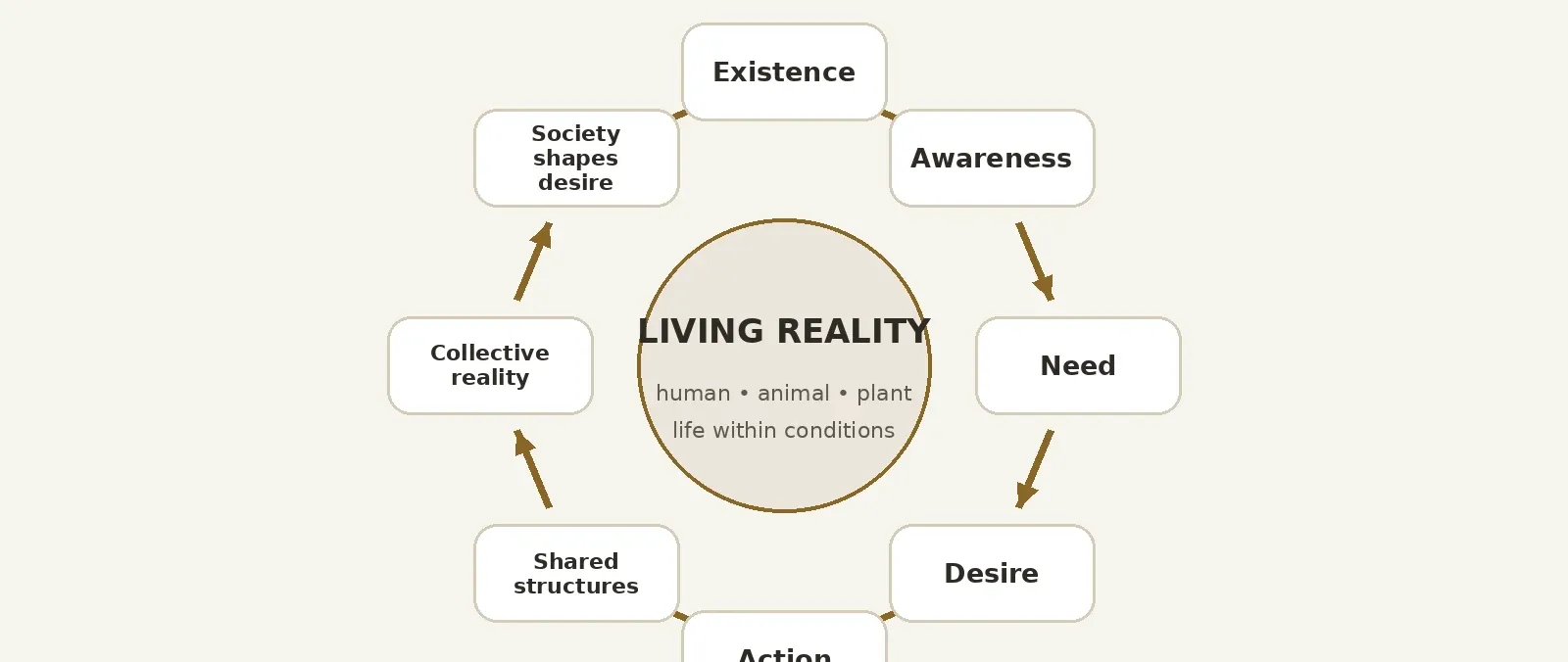
The cycle from existence and awareness through need, desire, action and collective reality. · Image: Truth By Reason original illustration
From the moment life exists, it encounters conditions, needs and pressures. In conscious beings these can become desires, actions and eventually shared structures, creating a circular relationship in which life shapes society and society shapes future desire.
Existence comes before desire
Before there can be desire, there must first be existence. A living organism appears within a physical world that it did not create, and that world immediately presents conditions such as temperature, hunger, danger, shelter, reproduction and contact with other living things.
At the simplest level these conditions do not need to be experienced as reflective human wishes. They may begin as biological drives, chemical responses or instinctive tendencies, yet they establish the basic pattern in which life is not merely present but is continually oriented toward what sustains, protects or extends it.
From need to imagined possibility
As awareness becomes more complex, need can become desire. A human being does not only experience hunger, fear or attraction but can imagine a condition that does not yet exist and then act in an attempt to bring that imagined condition into reality.
This ability transforms desire into a powerful creative force. A house exists first as the wish for shelter or permanence, a journey begins as the wish to be elsewhere, knowledge begins with the wish to understand, and institutions often begin with a wish for order, security, status, justice, belonging or control.
Desire therefore reaches beyond possession or pleasure. It can include the desire to know, to protect, to be loved, to dominate, to escape, to create, to preserve, to be remembered, to make meaning or to reduce suffering, and many structures of civilisation can be understood as accumulated attempts to satisfy such aims.
How desire becomes collective reality
Individual action rarely remains individual for long because living beings act in environments shared with others. Repeated actions become expectations, expectations become customs, customs become rules, and rules can eventually become institutions that appear to later generations as an already existing social reality.
Money is useful because people collectively recognise it, laws matter because communities create and enforce them, and borders, companies, universities, religions, markets and governments persist because human beings continue to behave as though these shared structures have meaning. They are real in their consequences even though much of their power depends upon collective recognition.
This suggests a sequence: existence leads to awareness, awareness encounters need, need can become desire, desire motivates action, and repeated action creates shared structures. Those shared structures then form part of collective reality and begin influencing the next generation of living beings who enter them.
The circle closes when society shapes desire
The process does not end when desire creates a social structure because the structure then begins producing new desires. A society built around money teaches people what money can obtain, a culture of status teaches people what counts as prestigious, and a technological environment creates desires that could not have existed before the technology itself existed.
Desire therefore creates society while society simultaneously creates the conditions in which future desire develops. The relationship is circular: desire changes the shared world, the shared world changes perception and expectation, and altered perception produces new desires that change the world again.
This circularity also explains why it can be difficult to know whether a desire is entirely one's own. Some desires arise from biological need, some from individual reflection, and others are learned through family, culture, advertising, religion, education, class, technology or the observation of what other people appear to value.
A living reality, not only a human one
The basic movement toward favourable conditions is not limited to human beings. Animals seek food, safety, mates, territory, companionship or relief from pain, while plants orient growth toward light, water and viable conditions even though describing these processes as conscious desire would go beyond what the evidence establishes.
It is therefore useful to distinguish desire in the reflective human sense from the broader tendency of living systems to move, grow or behave in ways connected with survival and flourishing. The common thread is not necessarily conscious wanting but the fact that life is dynamically related to conditions rather than passively detached from them.
Where the idea must remain limited
Calling collective reality a realm of desire is a philosophical model, not a claim that desire creates the physical universe. Gravity, disease, weather, mortality and material limits do not disappear because humans want otherwise, and the physical world continually constrains what desire can successfully turn into actuality.
Collective reality is also shaped by fear, coercion, accident, inherited systems, habit and unintended consequences. Desire is therefore not the only cause of civilisation, but it may be one of the central mechanisms through which conscious beings convert imagined possibilities into actions and actions into enduring social forms.
Evidence notes
This is a conceptual philosophical essay rather than a report of a single empirical finding. Its central distinction is between physical reality, experienced reality and collectively maintained social reality, and the argument concerns how desire may operate within the latter two rather than claiming that desire produces the physical universe.
The article also distinguishes reflective desire from biological drives and plant responses. That distinction prevents the metaphor of a universal realm of desire from being treated as evidence that every living organism possesses human-like conscious wanting.
Ethical questions
- How much of what we desire originates in our own reflection, and how much is supplied by the society around us?
- When institutions deliberately manufacture desire, what responsibilities do they have for the consequences?
- If collective reality is partly created by repeated human choices, which inherited structures should we continue to reproduce and which should we reconsider?
- Does recognising the circular nature of desire make us more responsible for the desires we encourage in other people and future generations?
Conclusion
Collective human reality can be understood as the continuously evolving materialisation of desire, constrained by the physical world and inherited from the desires, fears and actions of those who existed before us. We enter structures created by earlier lives, learn desires within them, act upon those desires and leave altered structures to those who follow.
The most important consequence of this model may therefore be a question rather than an answer. If desire helps create the world we share, then understanding where our desires come from becomes part of understanding what kind of reality we are collectively creating.
Sources used
- Truth By Reason original essay — Collective Reality: A Realm of Desire — Primary source