
Articles · Case study
Bahá’í Studies Conference Frames Scholarship as Service to the Common Good
An anniversary conference presents scholarship not as private expertise but as a form of service shaped by moral purpose.
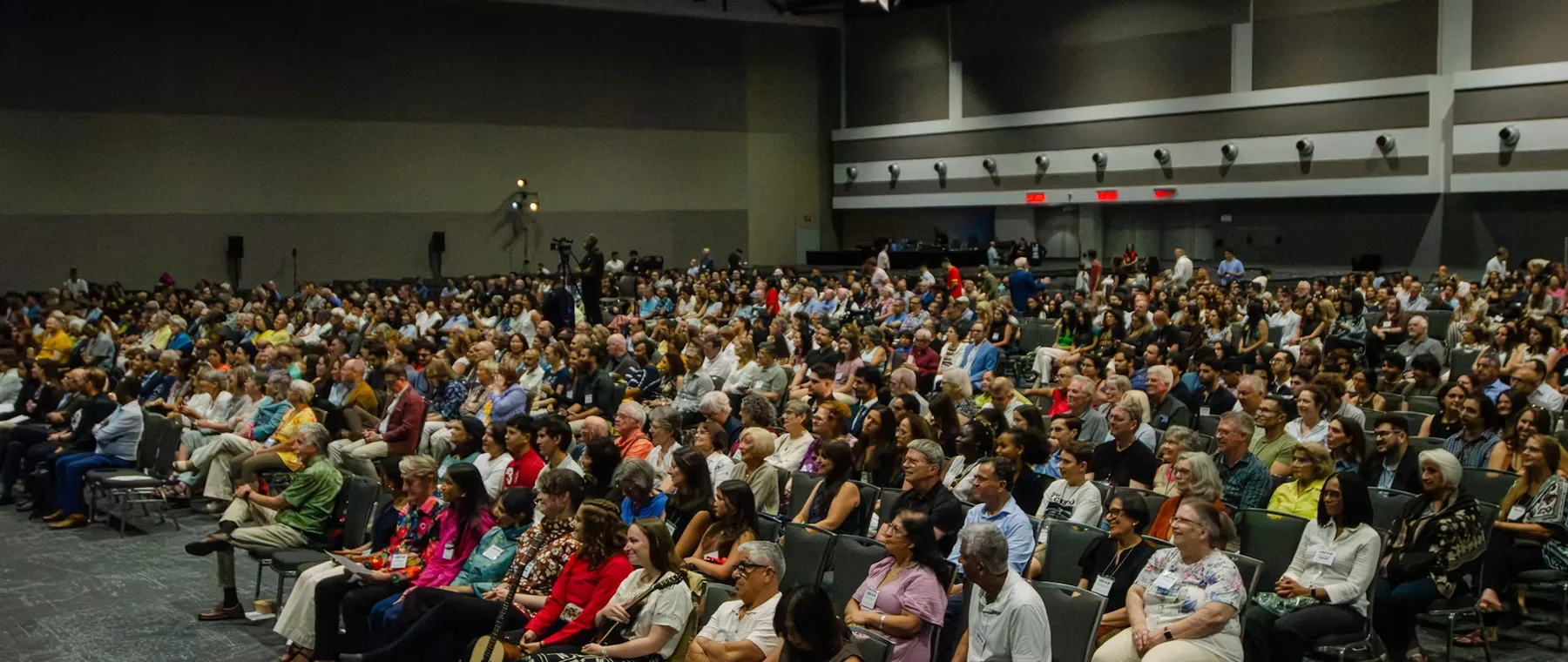
Participants at the Association for Bahá’í Studies 50th annual conference in Ottawa. · Image: Bahá’í World News Service
The Bahá’í World News Service reported that the 50th annual conference of the Association for Bahá’í Studies brought around 2,100 participants to Ottawa in 2026. The gathering included seminars on health, technology, media, education, the arts, mental health, scientific inquiry and community-engaged research, all framed around knowledge in service to the common good.
The conference broadens the idea of who produces knowledge
The Bahá’í account challenges the assumption that scholarship belongs only to universities and specialist journals. It presents knowledge generation as something that can occur in many social settings when people investigate questions carefully, exchange experience and subject ideas to disciplined reflection.
That broader view can be valuable, but standards still matter. Opening participation should not mean treating every opinion as equivalent to expertise; the strength of a claim still depends on evidence, method, criticism and whether conclusions survive contact with people who disagree.
Moral purpose is placed alongside intellectual inquiry
The conference theme treats scholarship as serving human wellbeing rather than as an activity detached from consequences. This fits a longstanding Bahá’í emphasis on the harmony of knowledge, moral development and service, while also raising a familiar philosophical question about whether inquiry should be directed toward predefined social goals.
Purpose can motivate important research, especially where neglected communities or practical problems receive too little attention. Yet inquiry also needs freedom to produce inconvenient conclusions, including findings that challenge the values or expectations of the community funding or hosting it.
Diverse fields create opportunities for cross-disciplinary learning
The reported programme ranged across health, technology, media, education, arts and scientific inquiry. Bringing those fields into one conversation can reveal connections that specialised disciplines miss, particularly when social problems involve technical, cultural and ethical dimensions at the same time.
The risk is superficiality if broad dialogue substitutes for deep expertise. A productive interdisciplinary setting therefore needs both openness and intellectual humility: participants should know when an issue requires specialist methods rather than assuming that moral seriousness alone is sufficient.
Religious communities can create alternative knowledge spaces
Faith traditions often maintain schools, study circles, conferences and publishing networks that sit partly outside conventional academia. These spaces can preserve long-term questions about ethics, meaning and community that may receive less attention in disciplines organised around narrower research incentives.
They can also become echo chambers if criticism is discouraged. The credibility of a religiously inspired scholarly community therefore depends on whether disagreement, external evidence and revision are genuinely welcomed when they threaten preferred conclusions.
The common good needs definition and scrutiny
“The common good” is an attractive phrase because few people oppose it in principle, but different communities may disagree sharply about what it requires. Scholarship becomes more useful when those assumptions are made explicit and when claimed benefits are examined for who gains, who bears costs and whose voices are missing.
From a TBR perspective, the strongest feature of the Bahá’í conference is its attempt to connect knowledge with responsibility. The strongest safeguard is equally clear: moral purpose should guide questions without insulating answers from evidence, criticism or the possibility of being wrong.
Evidence notes
The factual account comes from the Bahá’í World News Service report on the Association for Bahá’í Studies’ 50th annual conference. TBR’s existing Gleanings from Bahá’u’lláh and Selections from ‘Abdu’l-Bahá provide primary Bahá’í context.
Ethical questions
Can scholarship remain genuinely open if it is explicitly organised around a religious conception of the common good? What safeguards help faith-based intellectual communities welcome criticism from outside their own tradition?
Conclusion
The anniversary conference shows a religious community treating scholarship as an ethical activity rather than a purely technical one. That aspiration is valuable when service is combined with rigorous methods, intellectual freedom and willingness to revise conclusions.
Sources used
- Association for Bahá’í Studies at 50 — Scholarship and Knowledge in Service to the Common Good — Primary source
- Evidence — Academic / peer reviewed
- Gleanings from the Writings of Bahá’u’lláh — Mainstream secondary source
- Selections from the Writings of ‘Abdu’l-Bahá — Mainstream secondary source