Guides

Core guides and durable conclusions

A permanent library of explanatory work intended to remain useful beyond the daily article stream. Foundational Guides contain central TBR ideas or conclusions that should remain easy to find as the site grows.

Foundational Guides

Core ideas worth preserving

These pieces form part of the durable reasoning base of Truth By Reason.

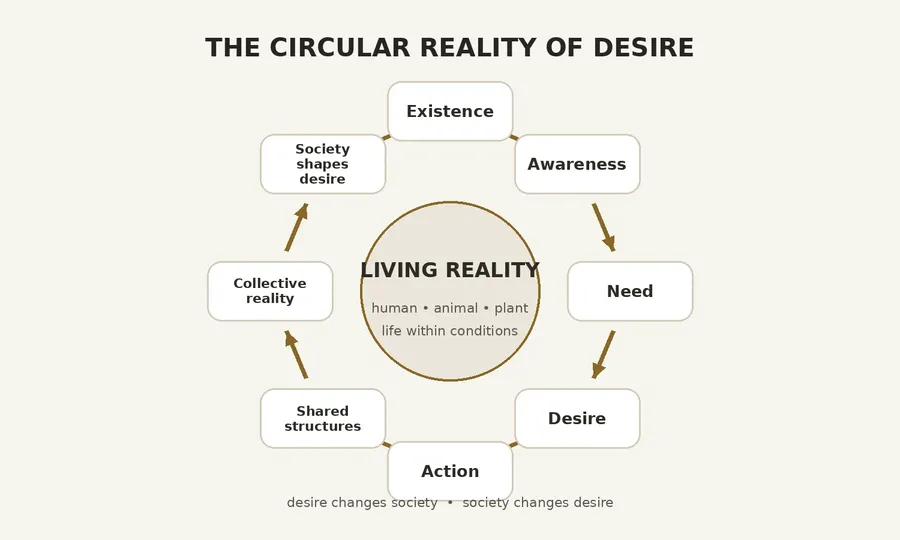
Collective Reality — The Circular Reality of Desire
Foundational Guide Philosophy & Reason

Collective Reality: A Realm of Desire

How existence, need, desire and action become the shared world that later shapes what we desire.

From the moment life exists, it encounters conditions, needs and pressures. In conscious beings these can become desires, actions and eventually shared structures, creating a circular relationship in which life shapes society and society shapes future desire.

Read guide →


Guides

Reference and explanatory guides

Guide to Environment and Our Future
Guide Environment & Land Management

A Guide to Environment and Our Future

Environmental questions combine physical evidence with ethical and economic choices. Good reasoning separates what science can establish from the value judgments involved in deciding which risks, costs and futures matter …

Read guide →
Guide to Human Rights
Guide Law, Justice & Punishment

A Guide to Human Rights

Human rights language expresses the idea that certain interests and freedoms should not depend entirely on status, wealth, nationality, religion or the goodwill of those in power.

Read guide →
Guide to Society and Culture
Guide Economics, Wealth & Poverty

A Guide to Society and Culture

People do not make choices in isolation. Families, institutions, laws, markets, technologies, traditions and social expectations all shape what seems normal, possible, admirable or forbidden.

Read guide →
Guide to the World's Religions
Guide Religion & Belief

A Guide to the World's Religions

Religions combine belief, practice, identity, ritual, community and moral life. Comparing them fairly requires attention to history, internal diversity and the different kinds of claims they make.

Read guide →
Ethics Without Slogans
Guide Ethics & Moral Living

Ethics Without Slogans

Moral language becomes easy when reduced to slogans. Real ethical problems are harder because values can conflict, consequences are uncertain and rules that work in one case may create injustice …

Read guide →
Evidence, Belief and Certainty
Guide Reasoning Tools

Evidence, Belief and Certainty

Belief is unavoidable; certainty is rare. Good reasoning asks not whether we can eliminate every doubt, but how strongly the available evidence should change our confidence.

Read guide →
How to Evaluate a Claim
Guide Reasoning Tools

How to Evaluate a Claim

Claims arrive wrapped in confidence, authority, emotion and repetition. A reliable method strips those away and asks what exactly is being claimed, what evidence supports it and what could prove …

Read guide →
Logical Fallacies: A Practical Guide
Guide Reasoning Tools

Logical Fallacies: A Practical Guide

Fallacies are recurring patterns of weak reasoning. Learning them is useful only if the label helps explain what went wrong, rather than replacing an argument with a vocabulary test.

Read guide →
Reading Sacred Texts Critically
Guide Scripture & Sacred Texts

Reading Sacred Texts Critically

Sacred texts matter deeply to billions of people, but reading them responsibly requires more than extracting a sentence and treating it as self-explanatory.

Read guide →

Research pathways

Go deeper than the guide

Evidence & conclusions

See the conclusions TBR has reached and the evidence behind them.

Explore Findings →

Sources library

Trace claims back to original sources, documents and institutions.

Browse Sources →

Thinkers

Follow philosophers, religious figures and influential thinkers across ideas and time.

Explore Thinkers →

Assessments

Use structured ethical and reasoning assessments to test decisions and claims.

Open Assessments →

How TBR works

Understand the method used to separate claims, evidence, reasoning and consequences.

Read the Method →

Latest Articles

Current work and developing ideas

View all articles
Ethics Without Slogans
Ethics & Moral Living

Ethics Without Slogans

Moral language becomes easy when reduced to slogans. Real ethical problems are harder because values can conflict, consequences are uncertain …

Reading Sacred Texts Critically
Scripture & Sacred Texts

Reading Sacred Texts Critically

Sacred texts matter deeply to billions of people, but reading them responsibly requires more than extracting a sentence and treating …

Evidence, Belief and Certainty
Reasoning Tools

Evidence, Belief and Certainty

Belief is unavoidable; certainty is rare. Good reasoning asks not whether we can eliminate every doubt, but how strongly the …

How to Evaluate a Claim
Reasoning Tools

How to Evaluate a Claim

Claims arrive wrapped in confidence, authority, emotion and repetition. A reliable method strips those away and asks what exactly is …

Guide to Environment and Our Future
Environment & Land Management

A Guide to Environment and Our Future

Environmental questions combine physical evidence with ethical and economic choices. Good reasoning separates what science can establish from the value …