
Articles · Case study
Dalai Lama Leads Novice Ordination in Dharamsala
An ordination ceremony offers a living example of how Buddhist traditions reproduce themselves through discipline, lineage and community.
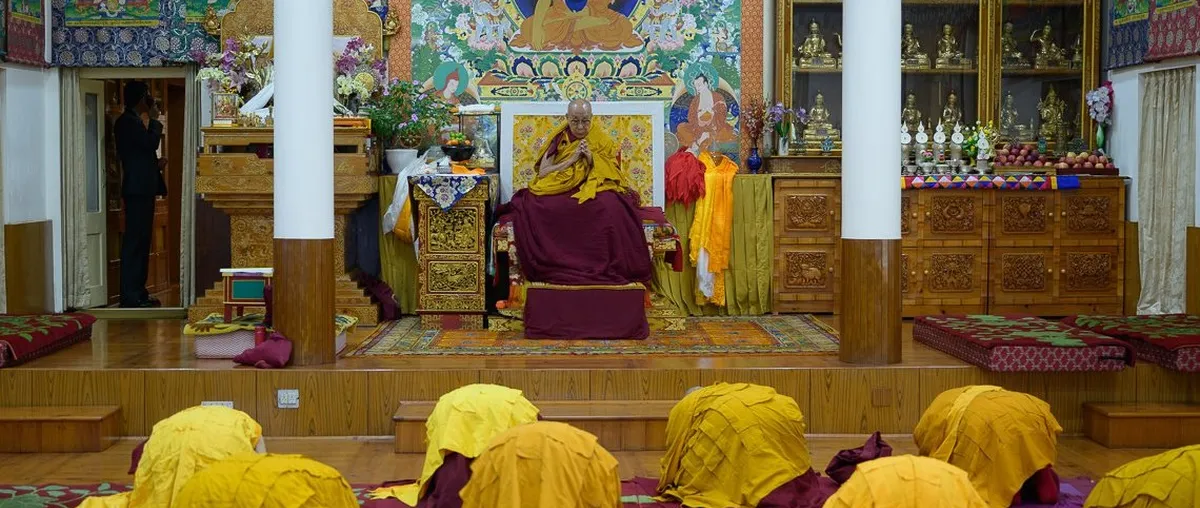
Senior monks and candidates at the novice monk and nun ordination in Dharamsala on 2 October 2026. · Image: Office of His Holiness the Dalai Lama / Ven Zamling Norbu
On 2 October 2026, the Office of His Holiness the Dalai Lama published a photographic record of a novice monk and nun ordination held at his residence in Dharamsala. The candidates were mostly from Taiwan, and the ceremony included instruction, ritual hair cutting, the blessing of robes, the conferral of ordination names and the presentation of Buddha statues to the newly ordained.
A tradition continues through people, not only texts
Religions survive because teachings are embodied in institutions, rituals and people willing to enter demanding forms of practice. The Dharamsala ordination is therefore more than a ceremonial event: it is part of the process by which Tibetan Buddhist monastic life is transmitted from one generation and region to another.
The official photographs show candidates moving through a sequence of recognisable ritual stages. Those visible actions matter because religious identity is not created only by holding beliefs; it is also shaped by public commitments, shared discipline and membership in a community that recognises the change in status.
The international character is significant
The Office of the Dalai Lama notes that the candidates were mostly from Taiwan. That detail illustrates the cross-border character of contemporary Buddhism, in which Tibetan traditions are studied and practised far beyond the Himalayan regions with which they are historically associated.
Global transmission can preserve a tradition while also changing the social settings in which it operates. Practitioners may carry monastic forms into societies with different languages, legal systems and expectations, creating a continuing tension between fidelity to inherited discipline and adaptation to local life.
Ordination makes discipline concrete
From a TBR perspective, one useful feature of monastic ordination is that it makes religious commitment observable. Vows, robes, ritual names and institutional relationships create clear expectations that can be compared with later conduct, rather than leaving spiritual aspiration as an entirely private claim.
This does not prove that a person will become wiser or more compassionate simply because a ceremony has taken place. It does, however, create a structured environment in which teachings can be studied, behaviour can be disciplined and accountability can be exercised by a community over time.
Ritual can carry psychological and social meaning
Hair cutting, robes and new names can function as markers of transition, helping participants understand that they are entering a different pattern of life. Similar mechanisms appear across many religions and secular institutions, where public ceremonies make commitments memorable and socially recognised.
The presence of senior teachers also gives the ritual a lineage dimension. The candidate is not merely choosing an individual lifestyle but entering a tradition that claims continuity with earlier generations of teachers and practitioners, which can strengthen identity while also increasing the importance of institutional responsibility.
The critical question is what follows
The strongest evidence for the value of an ordination is not the beauty of the ceremony but the life that follows it. If monastic training cultivates ethical discipline, compassion, learning and service, those outcomes can be examined in practice rather than assumed from religious status alone.
That is consistent with a broader principle of Truth By Reason: traditions deserve to be understood on their own terms, but claims about their benefits should still be open to observation, comparison and revision. Ritual may begin a commitment; conduct is what reveals how seriously that commitment is lived.
Evidence notes
The factual account and images come from the Office of His Holiness the Dalai Lama’s official 2 October 2026 gallery. The Dhammapada sources in TBR provide primary Buddhist material for comparison with the emphasis on disciplined conduct and training.
Ethical questions
How should a modern religious institution balance respect for inherited monastic rules with the needs of candidates from different cultures? What forms of accountability are appropriate when a ceremony confers spiritual authority or status?
Conclusion
The Dharamsala ordination shows Buddhism as a living institutional tradition rather than only a body of philosophical ideas. Its significance will ultimately be measured by whether the discipline, learning and ethical commitments represented by the ceremony are sustained in practice.
Sources used
- Dhammapada 1–2: The Chapter About the Pairs — SuttaCentral — Primary source
- Novice Monk and Nun Ordination in Dharamsala — 2 October 2026 — Primary source
- The Dhammapada: Chapter 1, The Pairs — BuddhaNet — Primary source