
Articles · Case study
Hindu American Foundation Uses Film to Challenge How Hinduism Is Taught
Religious communities increasingly produce their own educational media when they believe textbooks and public narratives misunderstand their traditions.
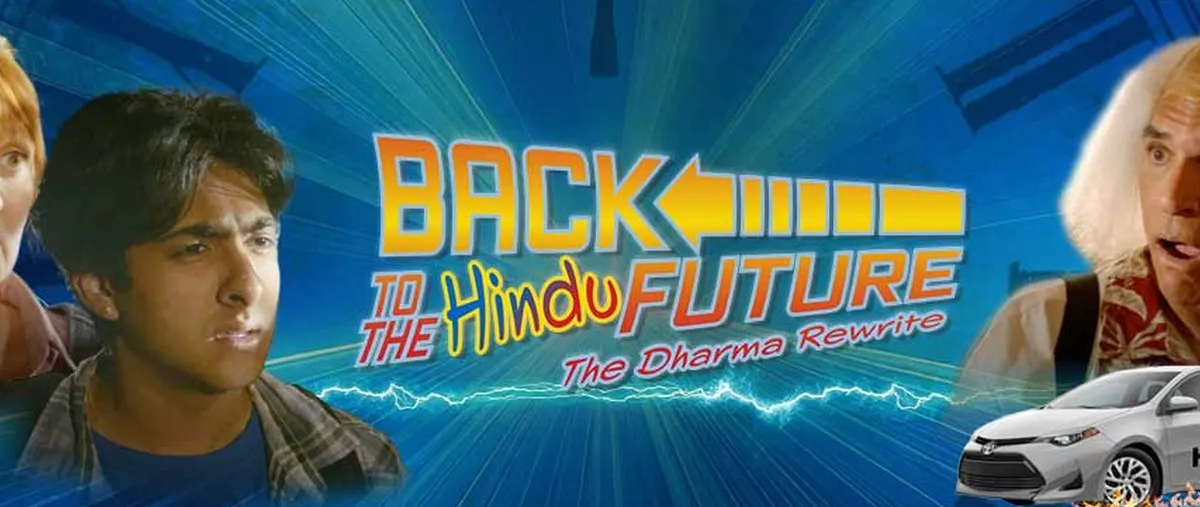
Official Hindu American Foundation artwork for Back to the Hindu Future, adapted to TBR’s article image format. · Image: Hindu American Foundation
The Hindu American Foundation’s September 2026 Chicago programme centred on its short film Back to the Hindu Future: The Dharma Rewrite. The organisation presents the film as a way to explore historical events and educational narratives that it believes have contributed to misunderstandings of Hindu traditions.
Representation in education affects real communities
School textbooks introduce many students to religions they may never encounter directly. Errors, oversimplification or loaded descriptions can therefore shape attitudes toward classmates and communities long after a lesson ends.
Religious organisations have a legitimate interest in identifying factual mistakes about themselves. They also have an interest in favourable representation, which is why educational material should not simply replace an outsider’s bias with an insider’s preferred narrative.
The film uses storytelling rather than a conventional lecture
HAF’s programme follows a fictional student who is dissatisfied with how Hinduism appears in a textbook and enters a time-travel story designed to revisit historical assumptions. That format reflects a broader shift toward entertainment-based religious education.
Stories can make complex issues memorable, but their persuasive power is precisely why viewers should ask which facts have been selected, which scholarly disputes remain unsettled and whether alternative interpretations receive fair treatment.
Insider knowledge is important but not sufficient
Members of a tradition often understand practices, language and lived experience that outsiders miss. Their testimony can correct caricatures and reveal how religious ideas function in everyday life.
Yet belonging to a tradition does not automatically make every historical or philosophical claim true. Good education benefits from both informed insider perspectives and independent scholarship capable of questioning community assumptions.
Hindu traditions are internally diverse
Any school treatment of Hinduism faces the difficulty that there is no single universal institution defining all Hindu belief and practice. Different philosophical schools, devotional traditions, regional customs and modern movements can disagree substantially.
This makes accuracy more demanding. A textbook should avoid presenting one interpretation as if it represented every Hindu, while community advocacy groups should also be clear about which traditions or positions they are describing.
The best test is transparent evidence
The strongest way to improve religious education is to identify specific disputed claims, provide primary sources and current scholarship, explain where experts disagree and invite revision when better evidence appears.
HAF’s film is useful as a prompt because it asks who gets to shape the story of a religion. TBR’s answer is that neither outsiders nor insiders should have unchecked control: claims should remain traceable to evidence and open to reasoned challenge.
Accuracy also means teaching internal disagreement
Religions are often presented in classrooms as fixed lists of beliefs, but real traditions contain debate about scripture, ritual, history, authority and social ethics. Students gain a more accurate picture when they learn that believers can disagree with one another while still identifying with the same broad tradition.
For Hinduism in particular, that means avoiding both crude stereotypes and overly tidy summaries. Educational material should explain diversity among schools, devotional movements and regional practices, while distinguishing historical scholarship from contemporary advocacy. That approach respects Hindu students without asking schools to adopt any organisation’s preferred theological account.
Evidence notes
The factual event source is the Hindu American Foundation’s Chicago 2026 programme page. TBR’s Bhagavad Gita source provides one example of primary Hindu scripture, while its general evidence framework is relevant to disputes over historical and educational claims.
Ethical questions
How much authority should religious communities have over how their traditions are described in public schools? What safeguards can prevent both stereotyping and the sanitising of difficult historical or ethical issues?
Conclusion
HAF’s project highlights a genuine problem: religious education can become inaccurate when communities are reduced to stereotypes. The durable solution is not control by any single group but transparent, plural and evidence-based teaching.
Sources used
- Back to the Hindu Future — Chicago 2026 — Primary source
- Bhagavad Gita 16:1–3 — Divine Qualities — Primary source
- Evidence — Academic / peer reviewed