
Articles · Investigation
How Base Rates Change Probability Judgments
Before asking how impressive a clue is, ask how common each possible explanation was to begin with.
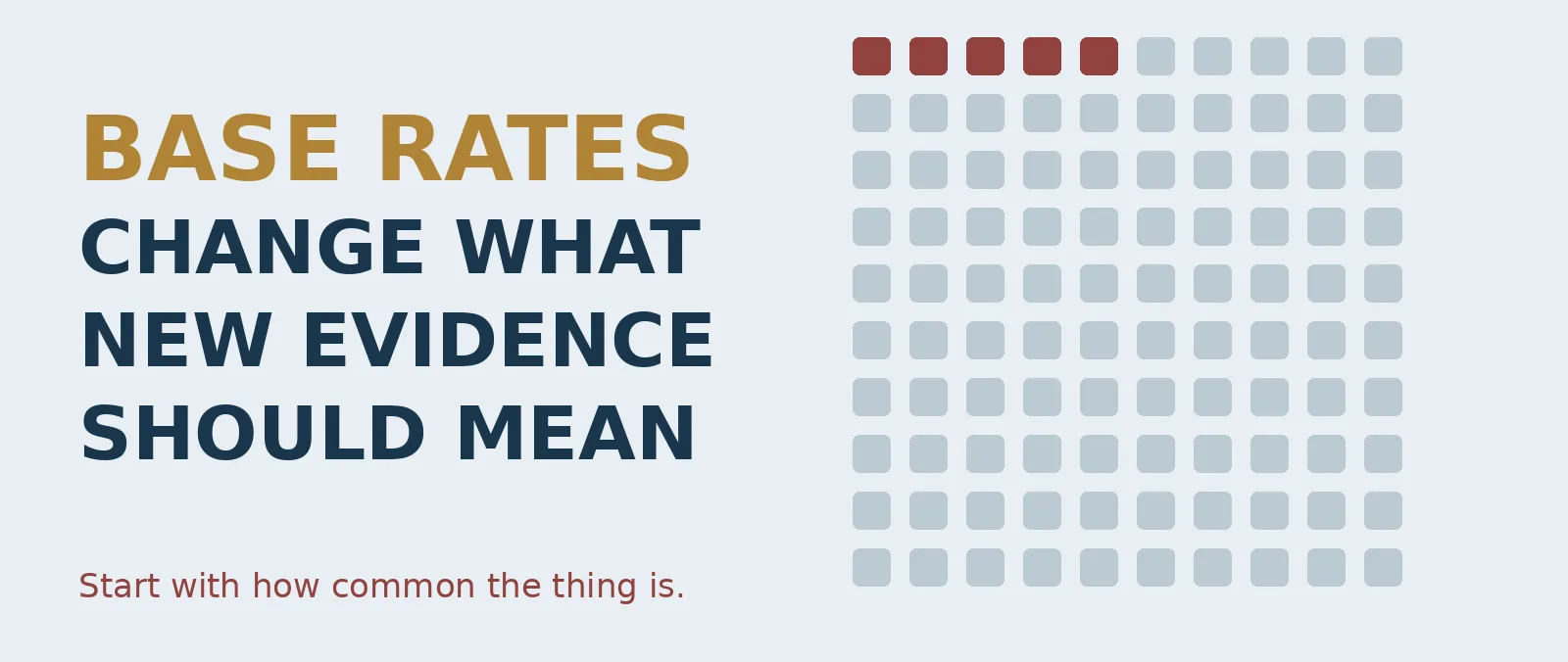
Original Truth By Reason illustration. · Image: Truth By Reason
A test result, behavioural clue or unusual observation can look decisive in isolation. But its real evidential weight depends partly on the base rate: how common the relevant condition or explanation was before the new evidence appeared.
A probability starts somewhere
Before new evidence arrives, we usually have some background expectation about how common an event is. A rare disease, a common mechanical fault and an unusual form of fraud begin with very different prior probabilities. Ignoring that starting point can make the same clue look far more decisive than it is.
Base rates do not settle the question by themselves. They provide the background against which new evidence should be interpreted. Strong evidence can overcome a low prior probability, but weak or moderately informative evidence may not.
Accurate tests can still produce many false positives
Imagine a condition that affects one person in a thousand and a test that correctly identifies almost everyone with the condition while falsely flagging a small percentage of healthy people. Because healthy people vastly outnumber affected people, false positives can outnumber true positives even when the test seems highly accurate.
The surprise comes from focusing on test accuracy while forgetting prevalence. What matters after a positive result is not simply “how often is the test right?” but “among people who test positive, how many actually have the rare condition?” Those are different probabilities.
Bayesian reasoning combines prior and new evidence
Bayesian reasoning formalises the idea that confidence should update from a prior probability in response to evidence. Evidence is especially informative when it would be much more expected under one explanation than under its alternatives.
This does not mean that every real-world judgment requires equations. The conceptual habit is often enough: identify plausible alternatives, estimate which were common beforehand, and ask how strongly the new observation distinguishes them. That alone prevents many intuitive errors.
Base rates matter outside medicine
Security screening, hiring, criminal investigation, equipment diagnosis and fraud detection all involve rare and common possibilities. If a behaviour is seen both among innocent and guilty people, its evidential value may be modest even when it sounds suspicious in a dramatic individual case.
Similarly, unusual success stories can be misleading when millions of attempts create many opportunities for coincidence. An event may be striking while still being expected somewhere in a very large population. Scale changes what should count as surprising.
Base rates should inform, not dominate
A rigid appeal to base rates can also mislead when the individual evidence is extremely strong or when the relevant subgroup differs from the general population. The right prior must match the question being asked, and genuinely diagnostic evidence should be allowed to change it substantially.
Good probability judgment therefore balances background frequency with case-specific evidence. The central discipline is to avoid treating a vivid clue as though it appeared in a statistical vacuum. When uncertainty is high, stating a range of plausible probabilities is often more honest than forcing a precise number that the evidence cannot support.
Evidence notes
Bayesian Epistemology and Formal Epistemology provide conceptual frameworks for updating degrees of belief in response to evidence. TBR uses base rates as a practical reasoning tool rather than as a demand for false numerical precision.
Ethical questions
When decisions affect liberty, healthcare or access to opportunities, what error rates are ethically acceptable? How should institutions communicate low-probability risks without causing people to overreact to dramatic test results?
Conclusion
Base rates remind us that evidence has context. A clue becomes meaningful only relative to the alternatives and their prior plausibility, so good judgment combines background frequency with the diagnostic strength of new information.
Sources used
- Bayesian Epistemology — Academic / peer reviewed
- Evidence — Academic / peer reviewed
- Formal Epistemology — Academic / peer reviewed