
Articles · Philosophy
How to Separate Facts, Interpretations and Values
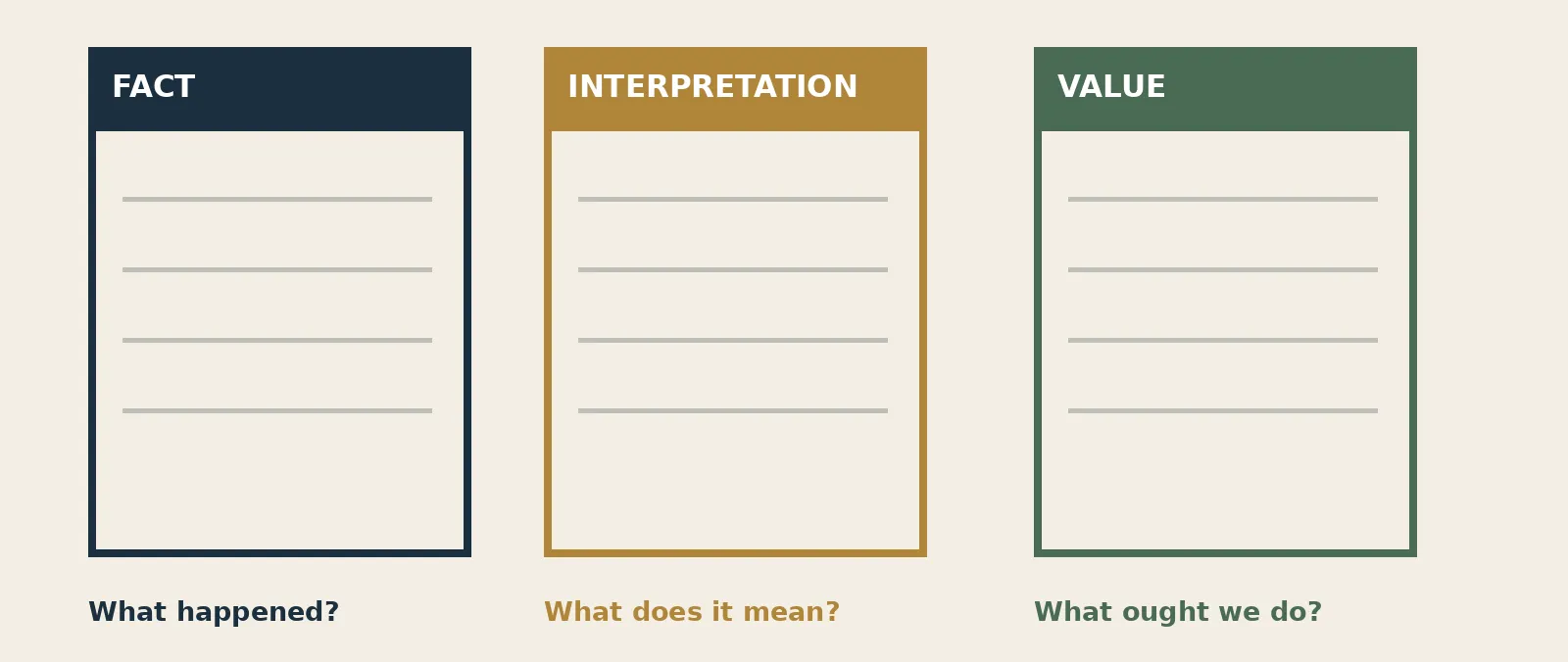
Many arguments become clearer when we ask whether people disagree about what happened, what it means or what ought to be done.
Original Truth By Reason illustration. · Image: Truth By Reason
A discussion can appear to be about one issue while actually mixing three different questions: what happened, how the evidence should be interpreted, and what should be valued or done. Separating those layers does not eliminate disagreement, but it makes the disagreement much easier to reason about.
Facts concern what is the case
Factual claims describe states of affairs: a law was passed, a measurement changed, a person made a statement, an event occurred on a particular date. Such claims can be supported or challenged using records, observations, measurements and other evidence.
Facts can still be uncertain. Sources may conflict, measurements may be noisy and records may be incomplete. Calling a question factual does not mean the answer is obvious; it means the disagreement is principally about what happened or what exists.
Interpretations organise facts into meaning
Two people can agree on a set of facts and disagree about what explains them. One may see an economic change as the result of policy, another as part of a wider cycle. Both are interpreting the same observations through different causal or conceptual frameworks.
Interpretations should therefore be judged by explanatory power, consistency with evidence, treatment of alternatives and the assumptions they require. They are not free inventions, but neither are they identical to the raw facts they attempt to organise.
Values concern what matters or ought to be done
Value judgments evaluate outcomes, duties, rights, virtues, harms or priorities. People may agree that a policy increases total income while disagreeing about whether the distribution is fair. The descriptive fact does not automatically decide the ethical question.
Values can be reasoned about, compared for consistency and tested against consequences. But they introduce normative premises that should be made visible. An argument becomes clearer when it says explicitly why a particular harm, liberty, duty or benefit should carry moral weight.
The three layers often interact
Separating facts, interpretations and values does not mean isolating them completely. Values influence which facts we investigate, interpretations affect predictions about consequences, and new facts can expose tensions in our moral positions.
The benefit of separation is diagnostic. When two people disagree, they can identify whether additional evidence could resolve the dispute, whether they need to compare competing explanations, or whether the remaining conflict concerns priorities that evidence alone cannot settle.
Labels can disguise the layer of disagreement
Political and moral language often compresses description and evaluation into a single word. Calling an action “reckless,” “just,” “authoritarian” or “responsible” may imply factual claims about behaviour while also carrying an evaluative judgment.
Good reasoning unpacks such labels. Ask what observable facts are being alleged, what interpretation links those facts together, and what standard makes the result good or bad. This reduces rhetorical confusion and makes each part of the argument answerable on its own terms. It also helps people discover when they agree about the evidence but are arguing past one another because their real disagreement is about explanation or moral priority. That distinction can make productive compromise possible.
Evidence notes
Philosophical work on truth, evidence and practical reason provides the conceptual background for distinguishing descriptive claims, explanations and normative reasons. TBR uses the distinction as a practical tool, not as a claim that facts and values never interact.
Ethical questions
Can apparently neutral factual descriptions hide value choices about what was measured or omitted? When does insisting on “just the facts” become a way of avoiding a necessary ethical judgment?
Conclusion
Separating facts, interpretations and values improves disagreement because it shows what kind of reason is needed at each stage. Evidence can establish facts, argument can compare interpretations, and ethical reasoning can make value choices explicit.
Sources used
- Evidence — Academic / peer reviewed
- Practical Reason — Academic / peer reviewed
- Reasons for Action: Justification, Motivation, Explanation — Academic / peer reviewed
- Truth — Academic / peer reviewed