
Articles · Case study
Latter-day Saints Use World Report to Present a Global Church
A semiannual media programme shows how a modern religion constructs a shared global identity across very different local communities.
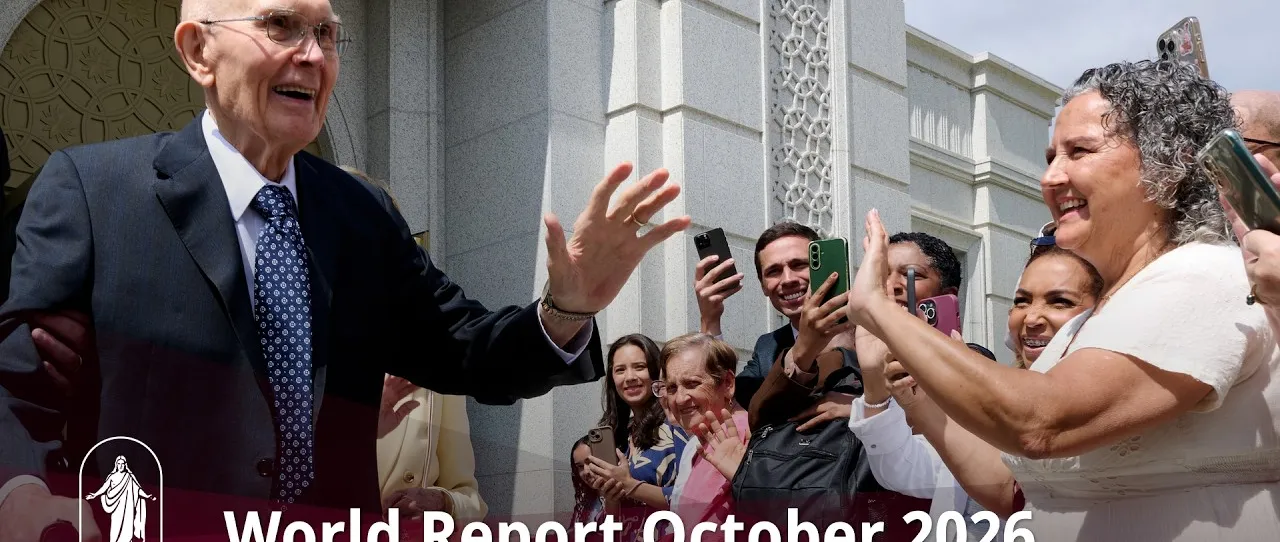
Official video image accompanying the October 2026 World Report. · Image: The Church of Jesus Christ of Latter-day Saints
The Church of Jesus Christ of Latter-day Saints released its October 2026 World Report on 30 September, offering a multilingual summary of church activity from the previous six months. The programme includes temple projects, humanitarian work, leadership activity and stories from communities in different countries.
A global church needs shared narratives
Religious institutions operating across many countries face a basic organisational challenge: local members experience very different communities, languages and social conditions, yet the institution also needs a common sense of identity. A global report is one way of creating that shared picture.
The October programme presents events from different regions as parts of one religious story. Temples, humanitarian projects and leadership visits are framed not as isolated events but as expressions of a single worldwide mission.
Media changes how religious authority is experienced
Historically, members of many traditions encountered religious authority mainly through local clergy, printed texts and periodic gatherings. Digital broadcasting allows a central institution to communicate directly with members across national borders and to do so in multiple languages almost simultaneously.
That reach can strengthen cohesion, but it also gives central communications teams considerable influence over which events represent the institution. A curated report necessarily selects some stories and leaves others out, so it should be understood as an official self-presentation rather than a neutral survey of everything happening within the church.
Humanitarian work is part of institutional identity
The World Report gives significant attention to charitable and humanitarian activity. This reflects a broader pattern across many religions in which service is both a practical expression of moral teaching and a public demonstration of institutional values.
From a TBR perspective, the relevant question is not whether religious motivation invalidates charitable work; it does not. The useful questions are whether programmes produce measurable benefit, whether recipients are treated with dignity and whether assistance is separated from coercive pressure to adopt religious beliefs.
Temple expansion signals continuity and growth
Temple projects occupy an important place in Latter-day Saint public communication because temples are central to distinctive religious practices and community identity. Announcements therefore carry both spiritual and organisational meaning.
Physical expansion alone does not establish the truth of theological claims, just as declining numbers would not by themselves disprove them. Growth can tell us about institutional vitality, resources and appeal, while doctrinal truth requires a different form of examination.
Official reports are useful when read critically
The World Report is valuable primary evidence for understanding how the Church wishes to describe its priorities. It tells researchers what leaders consider important enough to highlight and how they connect service, worship, temples and leadership into a unified narrative.
Responsible analysis should pair that official account with independent evidence where broader claims are made. Institutional self-description deserves to be heard accurately, but no organisation should be treated as the sole authority on its own social impact.
That distinction is especially important for global institutions with sophisticated media operations. A polished report can communicate genuine work effectively while still functioning as reputation-building, so viewers should separate the documented events from broader impressions about institutional success, growth or social value.
Evidence notes
The principal source is the Church’s own October 2026 World Report release. It is primary evidence for the institution’s self-presentation, while TBR’s general evidence framework is relevant when distinguishing official claims from independently established outcomes.
Ethical questions
How transparent should religious institutions be about the criteria used to choose stories for global communications? When humanitarian activity is presented publicly, what safeguards help keep service focused on recipients rather than institutional promotion?
Conclusion
The World Report offers a clear example of religion operating through modern global media. It is most informative when treated as both a record of real activity and a carefully curated statement about how the Church understands itself.
Sources used
- Evidence — Academic / peer reviewed
- October 2026 World Report — Church of Jesus Christ of Latter-day Saints — Primary source