
Articles · Case study
Pope Leo XIV Defends Silence in a World of Speed
A papal address raises a wider question: can deliberate silence improve attention, truthfulness and human relationships?
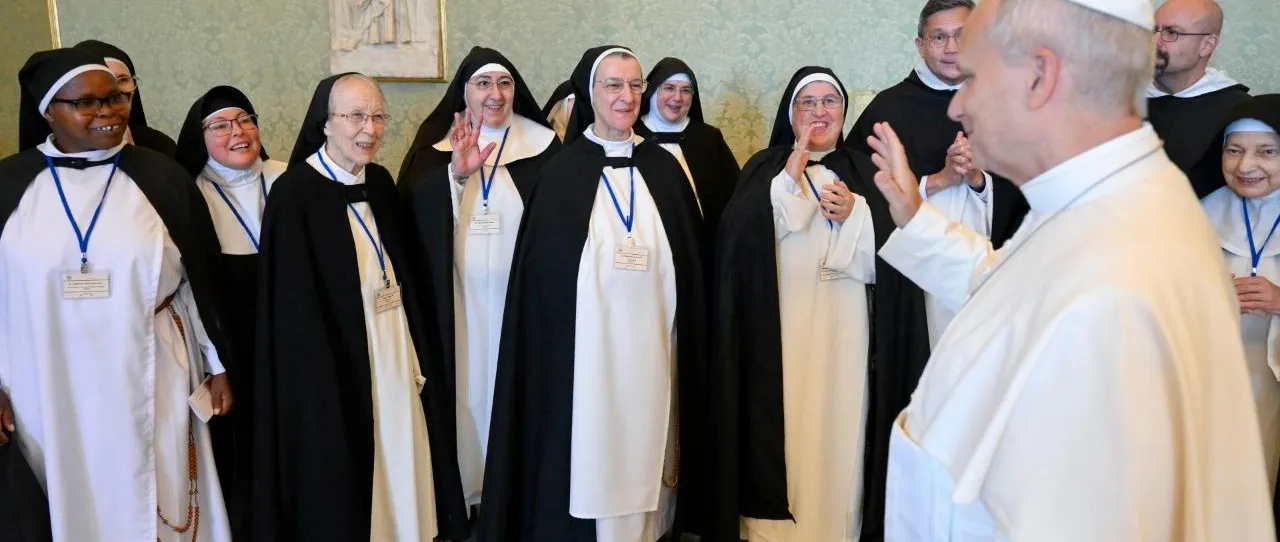
Pope Leo XIV during the meeting with members of the International Commission of Dominican Nuns. · Image: Vatican Media
Speaking to members of the International Commission of Dominican Nuns on 30 September 2026, Pope Leo XIV emphasised silence as a central part of contemplative life. Vatican News reported that he described silence as an intentional practice that can create space for freedom, truth, attention and sensitivity to people whose voices are easily ignored.
Silence is presented as an active discipline
The Pope’s remarks distinguish contemplative silence from mere absence of sound. He presents it as an act of will that involves the whole person, placing it alongside prayer, mutual listening, correction and reconciliation as part of a disciplined communal life.
That distinction is worth examining outside a specifically Catholic setting. Deliberately reducing noise and interruption can change how attention is allocated, while enforced silence can suppress communication, so the ethical value depends strongly on who chooses the silence and for what purpose.
The critique of speed has contemporary relevance
Vatican News reports that Pope Leo linked the value of silence to a world in which everything is expected to become immediately visible and empty space is rapidly filled. The observation resonates with digital environments built around notifications, continuous commentary and pressure to respond before reflection is complete.
There is no need to accept a theological explanation to recognise the practical problem. Constant stimulation can make sustained attention difficult, and rapid reaction can reward certainty, outrage and performance over careful thought, especially in public debate and social media.
Contemplative traditions provide structured experiments in attention
Monastic communities are unusual because they organise daily life around repeated practices of silence, prayer and shared routine. That makes them historically important examples of what happens when attention is treated as something to be trained rather than merely consumed by whatever is most urgent.
The existence of such traditions does not prove their spiritual claims. It does, however, provide a long-running social experiment in how environments, schedules and rituals can shape concentration, emotional regulation and interpersonal behaviour.
Silence can support listening only when power is considered
The Pope’s emphasis on becoming sensitive to voices that “do not count” introduces an ethical dimension. Silence can create room to hear another person, but institutions can also use expectations of quietness or obedience to discourage criticism, so religious communities need safeguards that distinguish contemplation from suppression.
This is especially important where authority is hierarchical. A healthy contemplative culture should make reflective silence compatible with reporting harm, questioning decisions and protecting vulnerable members rather than treating all speech as a failure of spiritual discipline.
The wider question is whether attention can be protected
TBR treats the papal address as a useful prompt rather than as proof that silence is universally beneficial. The practical claim can be examined: do deliberate periods without stimulation improve thought, listening, wellbeing or ethical decision-making, and under what conditions?
In that sense, contemplative practice can meet empirical inquiry. Religious language may supply the motivation and meaning, while psychology and behavioural research can help identify which effects are reliable, which people benefit and when silence becomes unhelpful or coercive.
Evidence notes
The factual account comes from Vatican News’ report of Pope Leo XIV’s 30 September 2026 meeting with Dominican contemplative nuns. The Catholic Catechism source in TBR provides an additional primary reference for Catholic moral teaching and practice.
Ethical questions
When does silence protect reflection, and when can it protect authority from scrutiny? Should schools, workplaces or digital platforms deliberately create periods in which people are not expected to respond immediately?
Conclusion
Pope Leo XIV’s defence of silence is most useful when treated as a testable and ethical proposition: attention may need protected space, but that space should support freedom, listening and accountability rather than obedience for its own sake.
Sources used
- Catechism of the Catholic Church 2447 — The Works of Mercy — Primary source
- Pope Leo XIV on Silence and Contemplative Life — Primary source