
Articles · Investigation
Why Anecdotes Are Weak Evidence
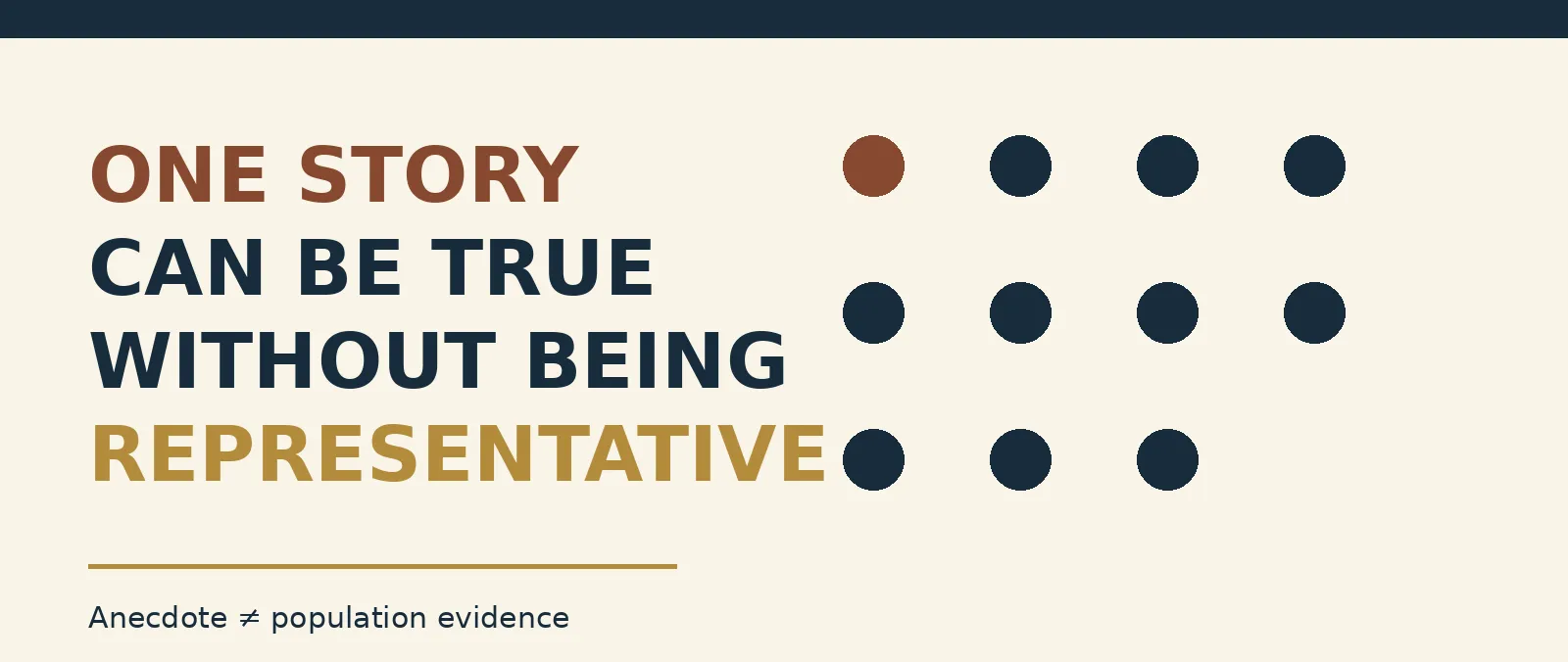
A vivid example can reveal a possibility without telling us how common that possibility is.
Original Truth By Reason illustration. · Image: Truth By Reason
People remember stories more easily than tables. A single dramatic recovery, failure, coincidence or personal experience can therefore feel more persuasive than a large body of impersonal evidence. The problem is not that anecdotes are necessarily false; it is that they are usually poor tools for estimating frequency, cause or general effect.
An anecdote can establish possibility
If someone reports an experience accurately, the story may show that a certain event can happen. One verified case of an unusual reaction, unexpected outcome or rare behaviour can be important because it may reveal a possibility that a general theory overlooked.
But possibility is a much weaker conclusion than prevalence. From one case we usually cannot infer how often the event occurs, whether it is typical, or whether the factor highlighted in the story caused the outcome. The anecdote answers “can this happen?” more readily than “what usually happens?”
Stories are selected, not randomly sampled
Anecdotes reach us through attention, memory and social selection. Unusual successes, disasters and coincidences are more likely to be retold than ordinary outcomes, so the stories available to us may be systematically unrepresentative of the underlying population.
This selection problem can be invisible. If ten thousand people try a remedy and five report extraordinary improvement, those five stories may circulate widely while the thousands who noticed nothing remain silent. Without a denominator, the emotional force of the testimony gives no reliable estimate of effectiveness.
Alternative explanations remain open
A person may improve after taking a treatment, lose money after following advice, or feel worse after changing a habit. The timing can be real while the causal interpretation is uncertain because symptoms fluctuate, other conditions change, expectations influence experience and unrelated events occur at the same time.
Controlled comparisons help because they ask what happened to similar people who did not receive the same exposure. An anecdote normally lacks that counterfactual comparison, making it difficult to separate the highlighted cause from background change, coincidence or regression toward a usual state.
Anecdotes are especially vulnerable to memory and framing
Personal reports are reconstructed from memory and shaped by what the teller believes is important. Details can be forgotten, reordered or interpreted differently over time without any intention to deceive. The resulting story may be sincere and still simplify a complicated sequence.
Framing also affects what listeners take from it. A story presented as a warning may emphasise harm, while the same sequence presented as resilience may emphasise recovery. The events do not automatically dictate the lesson drawn from them.
Good reasoning uses anecdotes in the right role
Anecdotes can generate hypotheses, identify rare problems, reveal overlooked questions and show how an issue feels to a real person. Those are valuable functions. The mistake is to treat a small, selected set of stories as though it were a representative study.
When a general claim matters, ask for broader evidence: rates, comparison groups, independent observations and methods that reduce selection bias. A story may tell us where to look. It should rarely be the last word on what the evidence shows.
Evidence notes
Philosophical work on evidence and testimony helps distinguish a sincere report from the broader inferences drawn from it. Scientific-method literature adds the need for comparison, sampling and methods that can separate an observed sequence from competing explanations.
Ethical questions
When a policy or medical decision affects real people, how should individual testimony be respected without allowing emotionally powerful cases to outweigh stronger population evidence?
Conclusion
Anecdotes are not worthless; they are limited. They are strongest as clues, examples and hypothesis generators, and weakest when used alone to estimate frequency, prove causation or settle a broad generalisation.
Sources used
- Epistemological Problems of Testimony — Academic / peer reviewed
- Evidence — Academic / peer reviewed
- Scientific Method — Academic / peer reviewed