
Articles · Investigation
Why Correlation Does Not Prove Causation
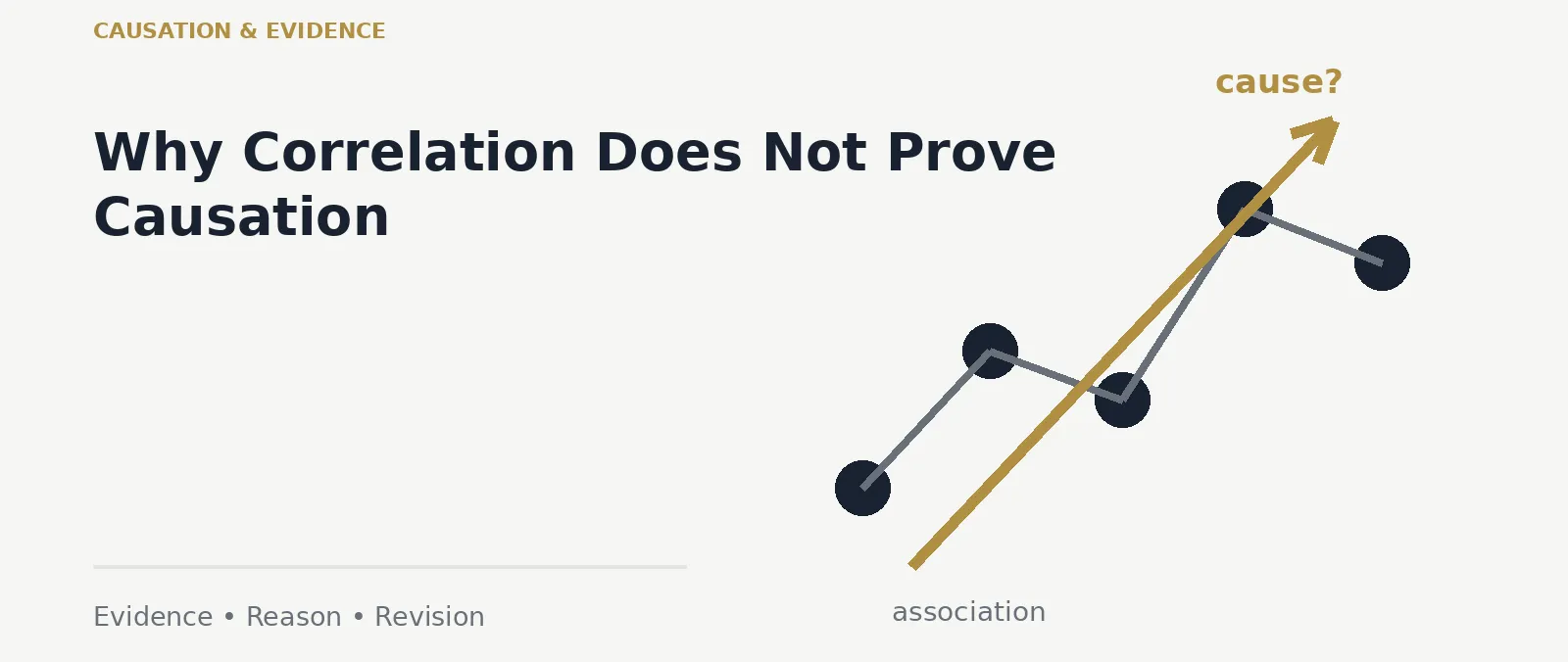
Association is a clue. Causation is an explanation that must survive stronger tests.
Original Truth By Reason illustration. · Image: Truth By Reason
Two things can move together very reliably and still have no direct causal relationship. Good reasoning therefore treats correlation as a starting point: something that may need explanation, not a certificate that one variable produced the other.
Correlation tells us that variables move together
A correlation is an observed association. When one variable changes, another tends to change with it in a regular way, and that pattern may be weak, strong, positive or negative. Correlations are valuable because they can reveal structure in data that would otherwise be easy to miss.
But a pattern alone does not tell us what generated it. If people who exercise more also have better health, exercise may contribute to health, healthier people may find exercise easier, or both may be influenced by income, age, diet, access to healthcare or other factors. The association is real even when the causal story remains unsettled.
Confounders can create convincing patterns
A confounder is a third factor related to both variables being studied. Hot weather can increase both ice-cream sales and sunburn, for example, creating an association between two outcomes that do not cause one another. In more serious research, confounders are rarely so obvious, which is why study design matters.
Researchers try to measure, control or randomise away plausible confounders, but no observational dataset automatically guarantees that every important factor has been captured. A large sample can estimate a correlation very precisely while still leaving the causal interpretation wrong. Precision is not the same as causal identification.
Reverse causation can invert the story
Even when two variables are directly connected, the direction may be uncertain. Stress may disturb sleep, poor sleep may increase stress, or the relationship may run in both directions. A simple association does not distinguish these possibilities because it records co-variation, not the temporal and counterfactual structure of the relationship.
This is one reason longitudinal studies, natural experiments and controlled interventions can add information that a snapshot cannot. If changing one factor while holding relevant alternatives stable produces a predictable change in another, the causal case becomes stronger. The question moves from “do these things occur together?” to “what changes when we intervene?”
Causal claims depend on comparison with alternatives
A good causal explanation should outperform plausible rivals. That may require asking whether the proposed cause comes before the effect, whether there is a credible mechanism, whether the pattern survives adjustment for confounders, whether dose or intensity matters, and whether similar findings appear in independent settings.
No single checklist mechanically proves causation in every field. Historical research, epidemiology, economics and laboratory science have different constraints, so the strength of inference depends on what evidence is realistically available. The common principle is that a causal claim must explain more than the bare correlation.
Causal models make assumptions visible
Modern causal models represent hypothesised relationships between variables and ask what follows under different interventions or counterfactual conditions. Their value is partly mathematical, but they also force researchers to state assumptions that might otherwise remain hidden. A model can show why some causal questions cannot be answered from a given dataset alone.
That is an important lesson for everyday reasoning. Data do not speak without assumptions about how the world works. The responsible approach is to identify those assumptions, compare alternative causal structures and keep confidence proportional to how well the evidence distinguishes between them.
Evidence notes
The Stanford Encyclopedia of Philosophy entries on scientific method, evidence and causal models explain why statistical dependence and causal explanation are distinct. Causal models can use correlations as evidence, but causal inference requires assumptions about interventions, alternatives and the structure linking variables.
Ethical questions
How much evidence should be required before acting on a suspected cause when the possible harm is serious? When would waiting for stronger causal evidence itself create an ethical cost?
Conclusion
Correlation is often informative, but it is not the final step. A causal conclusion becomes justified only when rival explanations, direction, confounding and the effects of interventions have been examined as far as the evidence allows.
Sources used
- Causal Models — Academic / peer reviewed
- Evidence — Academic / peer reviewed
- Scientific Method — Academic / peer reviewed