
Articles · Case study
World Jewish Congress Hosts Muslim-Jewish Dialogue on Peaceful Coexistence
Dialogue between communities under strain is most credible when it protects both honest disagreement and equal human dignity.
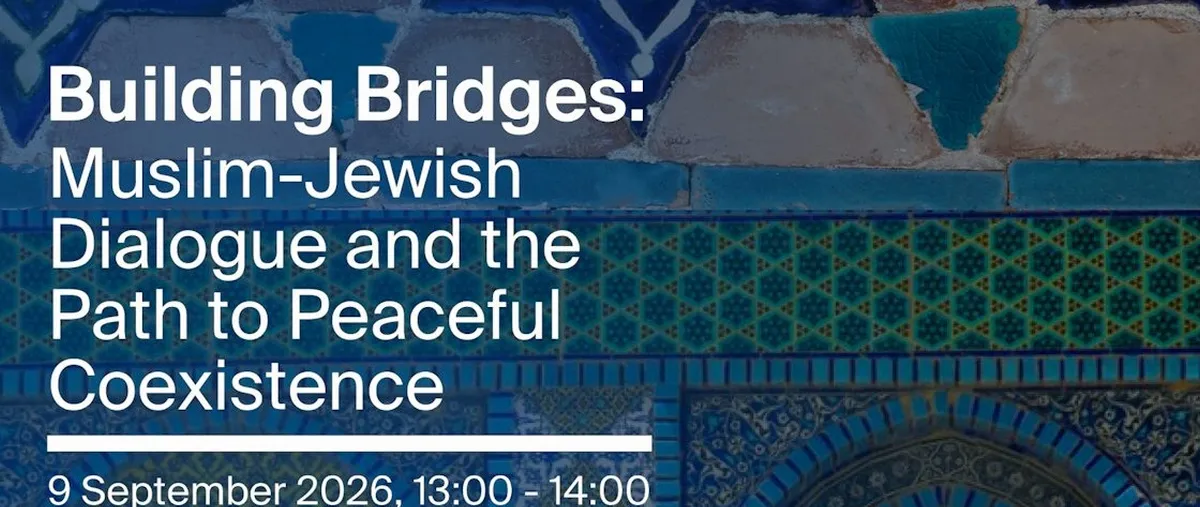
Official World Jewish Congress event artwork for its Muslim-Jewish dialogue in Geneva, adapted to TBR’s article image format. · Image: World Jewish Congress
The World Jewish Congress convened a Muslim-Jewish dialogue event in Geneva on 9 September 2026 alongside the UN Human Rights Council session. The gathering brought together diplomats, religious leaders and civil-society representatives to discuss religious intolerance, antisemitism, Islamophobia and peaceful coexistence.
Dialogue becomes harder when conflict is immediate
Muslim-Jewish dialogue is often discussed in abstract language about mutual understanding. In periods of geopolitical conflict, however, participants may arrive carrying fear, anger and strong disagreements about events affecting people with whom they identify.
That difficulty can make dialogue more valuable rather than less. It creates a channel in which communities can reject collective blame and maintain relationships even when their interpretations of political events remain far apart.
Antisemitism and Islamophobia should not compete for attention
Public debate sometimes treats concern for one form of religious hatred as though it weakens concern for another. That framing is unnecessary. Jewish communities can face antisemitic threats while Muslim communities face anti-Muslim prejudice, and both problems can exist at the same time.
A principled standard focuses on the treatment of people rather than the popularity of their group. Hatred, discrimination and violence should be opposed consistently even when communities disagree sharply about theology or international affairs.
Dialogue must allow criticism as well as respect
Peaceful coexistence does not require people to stop criticising religions, religious institutions or political actors. If dialogue is defined as avoiding every difficult subject, it can become superficial and fragile.
The more defensible goal is to separate criticism of ideas and actions from hostility toward people because of their identity. That distinction protects freedom of thought while also setting limits against dehumanisation and collective punishment.
Religious leaders can shape communal norms
Faith leaders cannot control every member of a community, but they can influence which language becomes acceptable and how followers interpret relationships with other groups. Public cooperation can therefore signal that disagreement does not justify hatred.
The test is whether leaders apply the same standards inwardly. Condemning prejudice from another community is easy; challenging harmful rhetoric among one’s own supporters is a stronger demonstration of principle.
Peaceful coexistence needs institutions, not only goodwill
Personal friendships and symbolic meetings matter, but durable coexistence also depends on law, equal rights, education, security and institutions capable of responding when tensions rise. Dialogue works best when it complements those structures rather than substituting for them.
The Geneva event is useful as one part of that wider system. Its long-term value will depend on whether relationships and principles established in public meetings continue to influence behaviour when communities face pressure and disagreement.
Success should be measured beyond attendance
Interfaith events often report the number and status of participants, but those measures say little about whether prejudice declines or cooperation improves. Stronger evaluation would look for follow-up initiatives, joint responses to hate incidents, changes in educational practice and durable communication channels between communities.
Those outcomes are difficult to attribute to one conference, yet they provide a better standard than ceremonial visibility alone. Dialogue becomes most credible when participants can point to specific actions that would probably not have happened without the relationships created through sustained engagement.
Evidence notes
The factual source is the World Jewish Congress’ 9 September 2026 event record. TBR’s international freedom-of-religion source provides a broader rights framework for assessing equal protection of Jewish, Muslim and other communities.
Ethical questions
How can interfaith leaders condemn hatred without turning dialogue into pressure to suppress legitimate criticism? What responsibilities do leaders have when prejudice comes from members of their own community?
Conclusion
Muslim-Jewish dialogue is most meaningful when it does not depend on agreement. The stronger standard is the ability to preserve equal dignity, reject collective hatred and maintain channels of communication through serious disagreement.
Sources used
- Building Bridges: Muslim-Jewish Dialogue and the Path to Peaceful Coexistence — Primary source
- Evidence — Academic / peer reviewed
- International Standards on Freedom of Religion or Belief — Official source